The first cold snap of the season has a way of exposing every weak point in a home’s water heater. A unit that quietly struggled all summer suddenly can’t keep up — recovery time slows, the water runs lukewarm instead of hot, and homeowners are left wondering whether they’re looking at a quick fix or a full replacement.
It’s a fair question, and not always an obvious one. A ten-year-old tank making a little noise might have years left. A five-year-old tank with a slow leak at the base might not be worth saving at all. The age on the sticker matters less than what’s actually happening inside the tank. Knowing the difference before calling someone out can save a homeowner from paying for a repair that was never going to hold.
At Machias Power and Plumbing, we field this call constantly, and the answer isn’t always the one homeowners expect. As a dual-trade contractor licensed in both electrical and plumbing, our team can look at a failing water heater and immediately flag whether the real issue is the tank, the gas line, or the circuit feeding it.
How Old Is Too Old?
Most conventional tank water heaters are built for a service life of 8-12 years. Tankless units run longer, often 15-20 years, since there’s no standing tank to corrode from the inside out.
Age alone isn’t a verdict, but it does change the math. A repair on a 4-year-old unit is usually worth it. The same repair on a 12-year-old unit, especially if it’s the second or third fix in a few years, is often just delaying a replacement that’s already overdue.
The manufacture date is usually on the rating plate near the top of the tank, often hidden in the serial number rather than printed as a plain date — worth checking before assuming a unit is newer or older than it is.
Warning Signs Worth Paying Attention To
Some signs point toward a straightforward repair. Others are the tank telling you it’s done.
Signs that often mean repair is enough:
- Pilot light won’t stay lit, but the tank itself is sound
- A single failed heating element or thermostat on an electric unit
- Reduced hot water from sediment buildup that a flush can resolve
- A faulty temperature and pressure relief valve
Signs that usually mean replacement is the better call:
- Rust-colored water coming from the hot side only, especially right after the tank sits unused
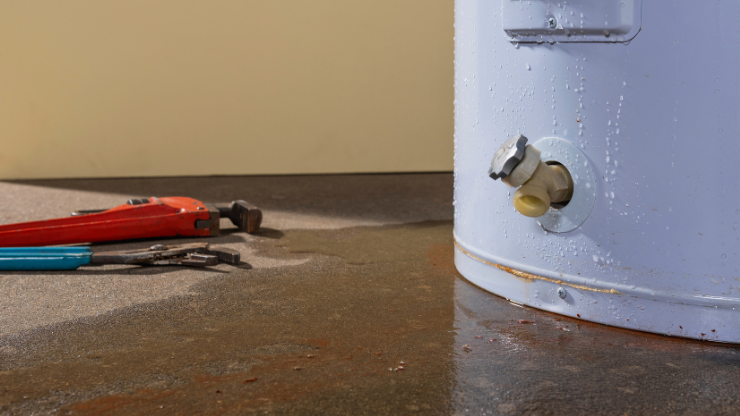
- Any moisture or pooling around the base of the tank itself, not just a fitting or valve
- Popping or rumbling sounds from heavy sediment that’s hardened over years
- A tank that’s 10+ years old and now needs a major repair
- Inconsistent temperatures that swing hot and cold with no clear cause
Rust at the base is the one sign that could end the conversation quickly. Once the tank itself is corroding, no repair puts that metal back.
Why the Repair Sometimes Isn’t Worth It
A repair that costs a few hundred dollars can look like the obvious choice next to a full replacement. The math changes once a homeowner looks at what’s actually being repaired versus what’s aging alongside it.
An anode rod, thermostat, or heating element failing on a tank that’s otherwise young is a clean fix. The same part failing on a tank already past its expected service life is usually the first of several calls, not the last. Homeowners who repair a 10-year-old tank often find themselves replacing it within a year or two anyway — at which point the repair cost was money spent on a unit that was already on its way out.
Fuel type matters too. A homeowner switching from electric to gas, or considering a tankless upgrade for a growing household, may be better served putting repair money toward the new install instead.
How Machias Approaches Water Heater Calls
As trusted plumbing professionals serving Snohomish, King, and Skagit Counties, we encounter a wide variety of water heaters — original builder-grade tanks still running in older homes, mismatched replacements from previous owners, and the occasional tankless unit installed without the electrical or gas line upgrades it actually needed.
Here’s what a typical call looks like:
Contact us. Tell us what you’re noticing — no hot water, rust-colored water, a leak at the base, strange sounds. That first conversation helps us gauge whether it sounds like a simple fix or something more serious before we ever step on-site.
We visit and assess. A licensed technician analyzes the unit itself: age/manufacture date, fuel type, visible corrosion, leaks, and how the symptoms line up with what’s actually failing.
We get to work. If it’s a repair, we fix it and explain why it’ll hold. If it’s a replacement, we’ll walk you through your options — tank or tankless, gas or electric — and flag any electrical or gas line upgrades the new unit will need, to ensure there are no surprises throughout.
We follow up. After the work is done, we check back in to make sure the fix held, the new unit is performing the way it should, and nothing else needs attention.
Because Machias handles both trades, a water heater replacement that needs a dedicated circuit, an upgraded gas line, or a panel that can’t support a new electric unit gets handled in one swift visit. That matters more often than homeowners expect, especially with tankless conversions, which frequently require electrical work.
Repair or Replace? Find Out Today
A water heater on its way out rarely fails quietly, and guessing at repair versus replacement usually costs more than getting a straight answer up front.
Whether your unit needs a quick fix or its time is up, the sooner you find out, the sooner you’re back to reliable hot water — not another round of patch jobs.
To schedule a diagnostic or talk through what you’re noticing, contact us today.